Finance & billing guide
Audience: Redd Ash finance and superadmins. Billing management lives on admin.reddwatch.com — the cross-instance control plane. The integrator consoles (appXXX instances) carry an overview only.
The model
Reddwatch bills integrators, not gadgets. An integrator's monthly position is the sum of their clients' plans, consolidated into one commercial relationship — no matter how many sites or instances they grow into. End clients see their plan and service status in their portal; they never receive an invoice from us.
flowchart LR
    RA["Redd Ash<br/>(admin.reddwatch.com)"] -->|"one consolidated position<br/>per integrator"| INT["Integrator"]
    INT -->|"their own commercial terms"| C1["Client site A"]
    INT --> C2["Client site B"]
    INT --> C3["Client site C"]
Where finance works: admin.reddwatch.com → Billing
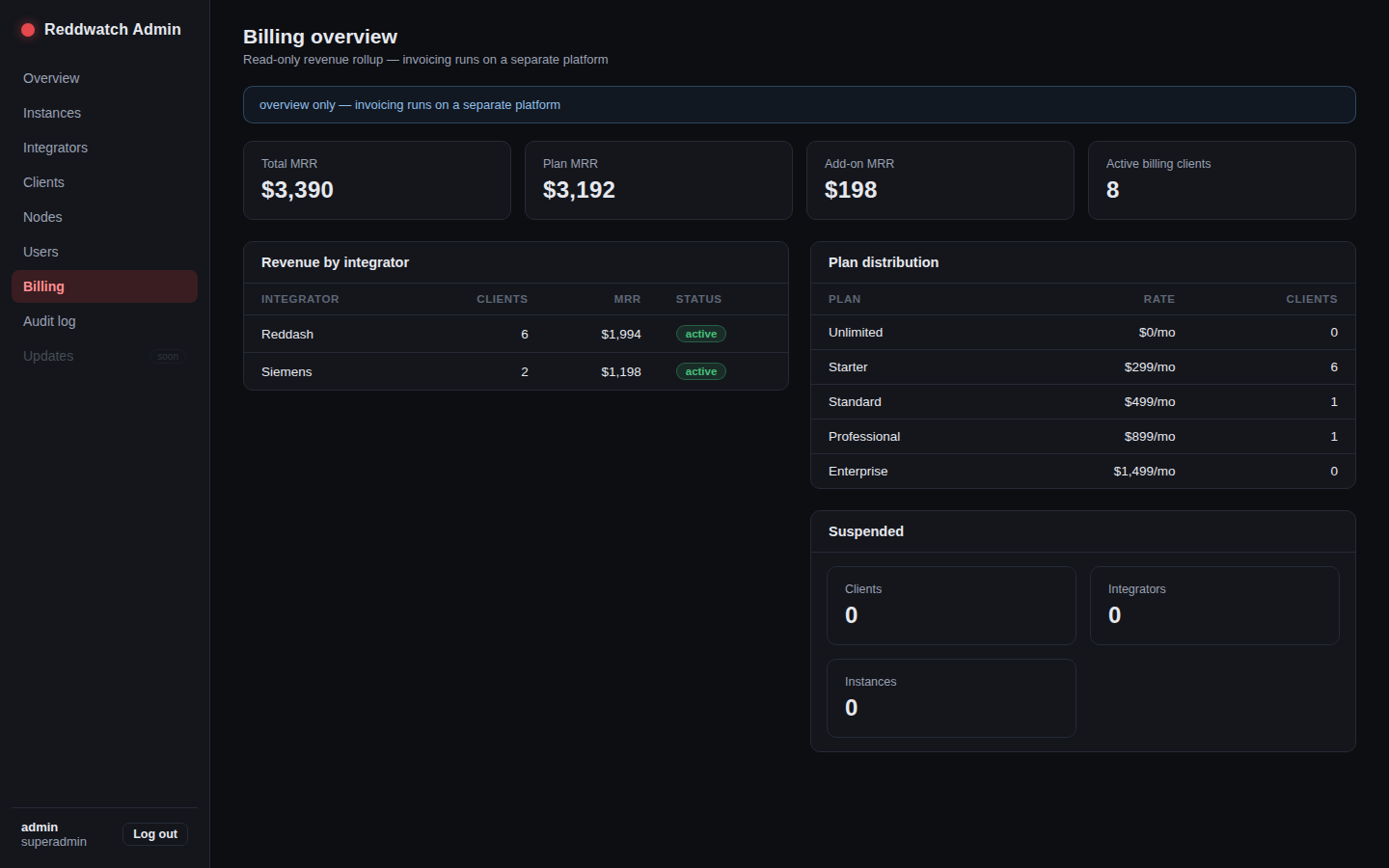 The control-plane billing overview: MRR rollup, revenue by integrator,
plan distribution, and suspension counters — across every instance.
The control-plane billing overview: MRR rollup, revenue by integrator,
plan distribution, and suspension counters — across every instance.
What you get, in one read-only view:
- Total / Plan / Add-on MRR — the fleet-wide recurring position.
- Revenue by integrator — client count, MRR, and account status per integrator; this is the consolidation the monthly statement is built from.
- Plan distribution — how many clients sit on each rate.
- Suspended — live counters for suspended clients, integrators, and instances.
Overview only — by design
The console states it on the page: invoicing runs on a separate platform. admin.reddwatch.com aggregates and reports; it does not generate invoices. That keeps the control plane out of the money path while staying the single source of truth for what to bill.
Suspension (the commercial lever)
Suspend lives on the control plane, at three levels — client, integrator, or whole instance — and is soft: the portal flags and restricts the account, but monitoring keeps collecting. Dropping a safety net entirely is a deliberate decommission, never a billing side effect.
What integrators see (appXXX consoles)
Inside their own instance, integrators get a billing overview — per-client plan and account status — enough to reconcile against the consolidated statement and to answer "what plan is this site on."
Plan configuration and lifecycle changes are control-plane actions; if an integrator needs a plan changed, that's a request to Redd Ash, applied on admin.reddwatch.com and visible in their console immediately.
What's included in a plan (typical)
| Component | Notes |
|---|---|
| Site node appliance | provisioned + managed + auto-updating |
| Device monitoring | all classes: cameras, network, servers, access control |
| Camera frame verification | scheduled captures + anomaly detection |
| RF link telemetry | where wireless backhaul exists |
| Alerting & escalation | email/SMS, on-call chains, storm protection |
| Reporting | branded PDF, daily/monthly/custom period |
Practical notes
- Device and client counts come from the live inventory — the same numbers operations sees, so commercial and technical never argue about quantities.
- The per-integrator consolidation feeds the external invoicing platform; the admin overview is the reconciliation reference.