Product overview
Reddwatch is monitoring built for physical security — the operational platform between "the city bought 200 cameras" and "someone actually knows they all work."
The problem
A modern surveillance deployment is a fragile chain: cameras hang off pole switches, pole switches ride wireless backhaul, backhaul lands in a head-end server room. Generic IT monitoring treats each box as an island — so when a single radio fades in coastal weather, the on-call phone melts with alerts for every camera behind it, and nobody can tell the cause from the symptoms. Meanwhile the failures that actually cost money — a camera slowly going blurry, a lens painted over, a link running at half quality — never trip a ping check at all.
What Reddwatch does differently
Dependency-aware alerting. Reddwatch maps the site topology — which cameras sit behind which switch, which switch rides which radio — and collapses an outage to its root cause. One alert: "Pole 8 radio down — 4 devices affected." Not forty.
Camera frame verification. On schedule, every camera's live frame is captured and compared against its reference image. Blur, dirt, tampering, repositioning, and dead feeds are flagged with a similarity score and the evidence side by side.
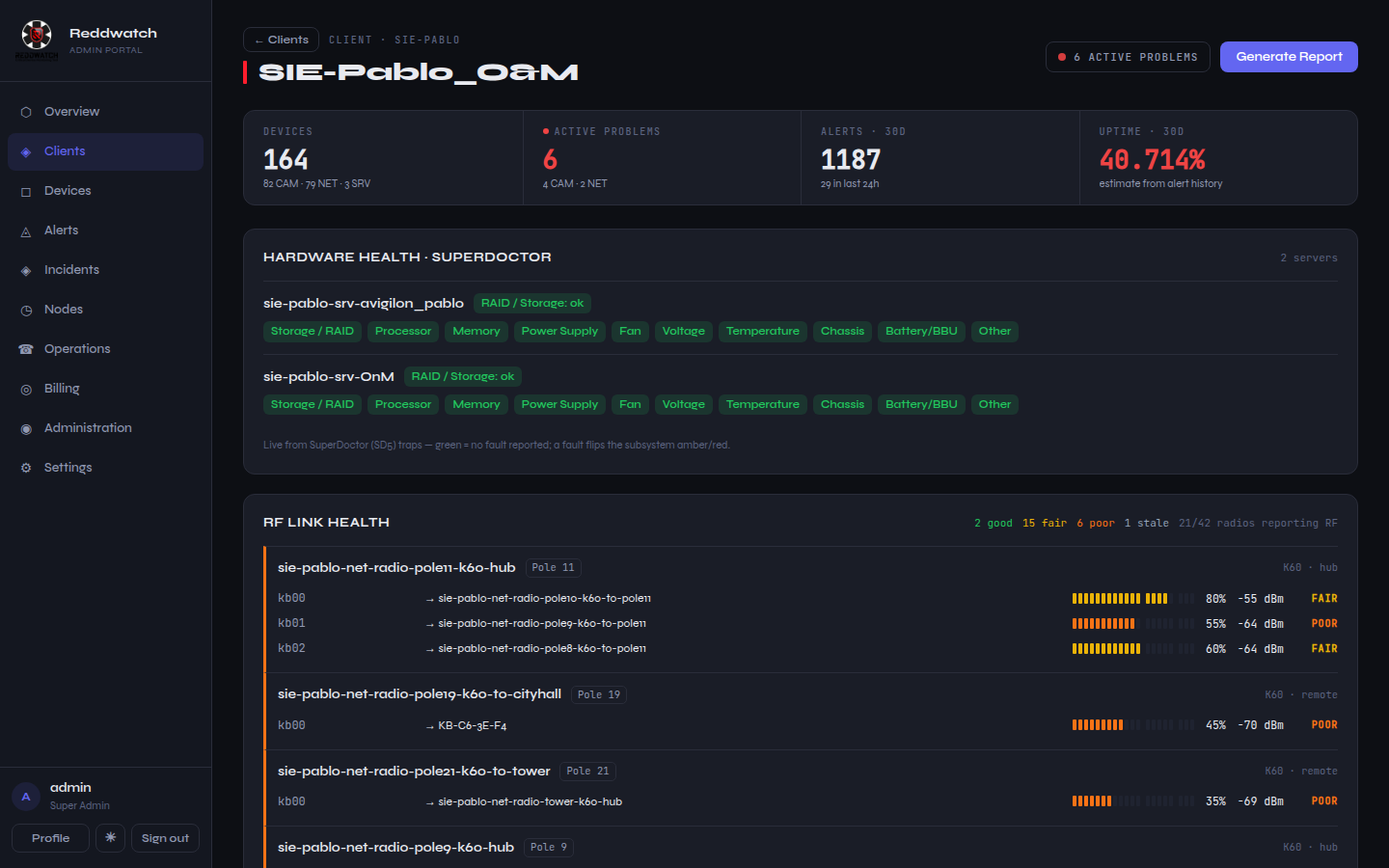
RF link health. For wireless backhaul (60 GHz and licensed links), Reddwatch reads quality and signal levels from the radios themselves and shows every link as a live meter — so a link degrading from 90% to 45% gets a field visit before the overnight fade takes the site down.
The site node appliance. Each site gets a small pre-provisioned box that discovers the local network, proxies all monitoring over an encrypted overlay (no inbound firewall holes at the site), captures camera frames, and keeps itself updated with signed, automatically-rolled-back releases.
Integrator-grade multi-tenancy. Integrators manage their own clients in their own portal scope; their operators get read-only triage views; end clients can receive branded status and PDF reports. Tenants never see each other.
The numbers that matter
- Alert noise: root-cause collapse + storm suppression means an outage is one actionable alert, with the affected-device count attached.
- Site onboarding: a node ships pre-provisioned; on-site setup is plug in, type the site code, done.
- Failure classes covered: reachability, service health, hardware (RAID, PSU, fans via server telemetry), RF link quality, and visual camera verification — the full chain, not just ping.
Talk to us
Redd Ash Technologies · Mount Dora, FL · reddwatch.com · (407) 901-3192