Operator guide
Audience: operators on the desk — you watch the board, triage what fires, and escalate what's real. You have view/acknowledge rights, not configuration rights.
Reading the board
Start at the overview, then work per-client:
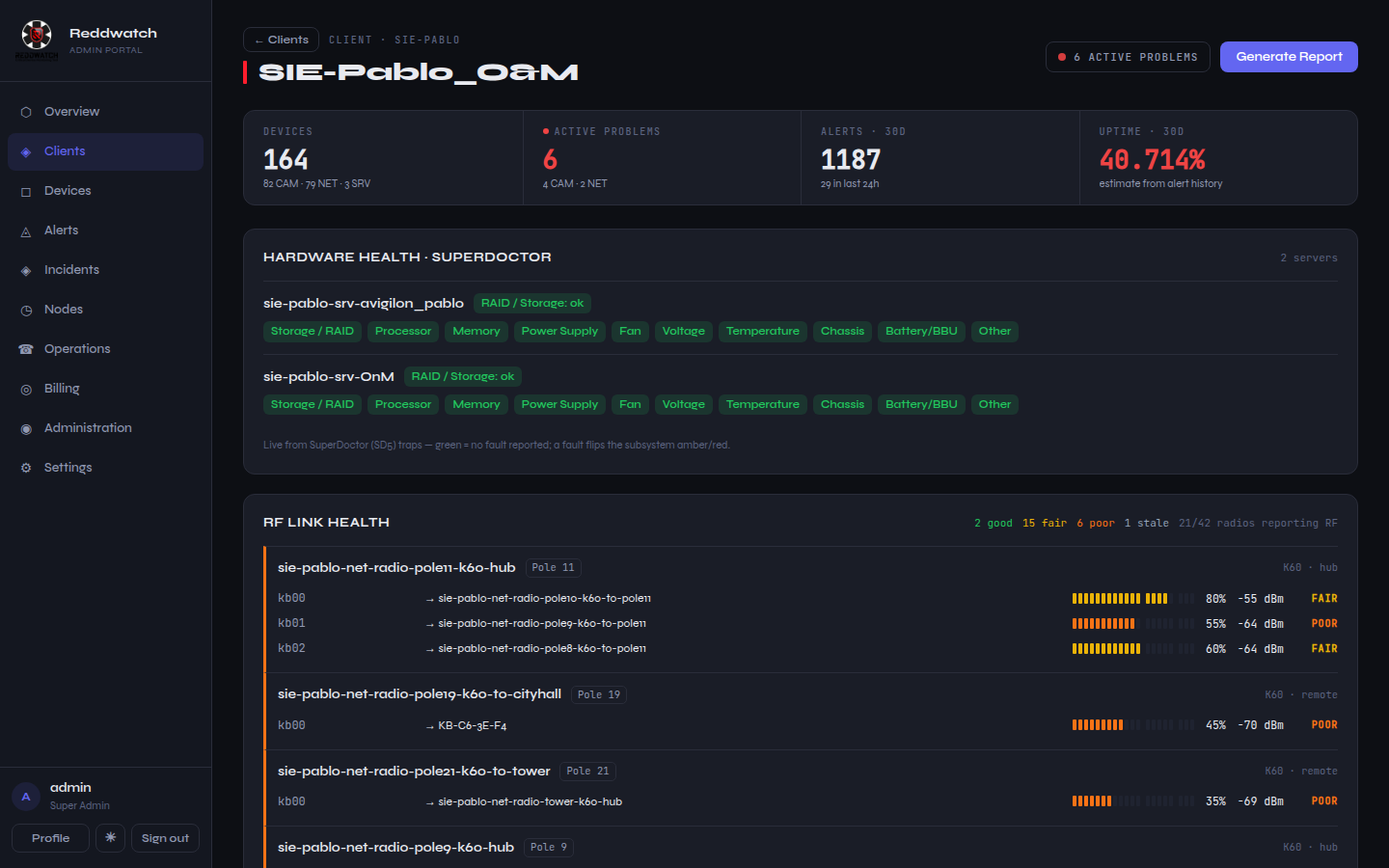 A client dashboard. Top strip: device count, active problems, 30-day
alert volume, uptime. Below: hardware health, RF links, live problems.
A client dashboard. Top strip: device count, active problems, 30-day
alert volume, uptime. Below: hardware health, RF links, live problems.
The three habits that matter:
- Believe the root cause. When an alert says Root Cause — 4 downstream affected, the four dependents are already suppressed. Work the root; don't chase the echoes.
- Check the rail colors. Every list on the page speaks the same language: green = good, yellow = degraded, orange = poor, red = down, grey = no fresh data. A grey that should be green is a finding.
- Ack what you own. Acknowledging an alert stops escalation and stamps your name on the timeline. Unacked criticals climb the on-call chain by design.
Triage flow
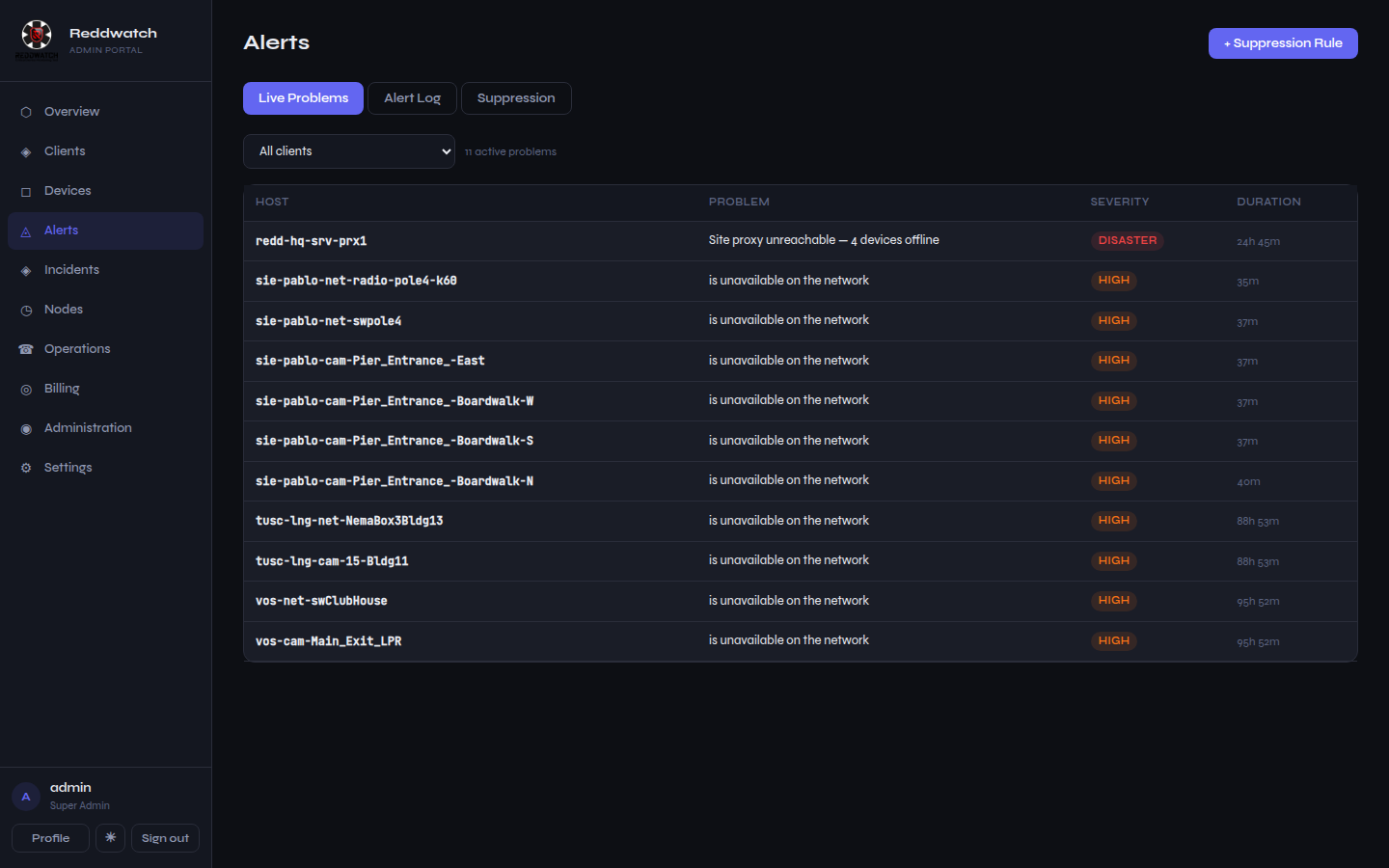
- Live Problems — what's broken now. Filter by device type. Click through for the event timeline and acknowledgment.
- Alert Log — the recent history with durations and resolution state; your shift-handoff view.
- Badge vocabulary: NETWORK = device unreachable · SOFT = service/ threshold issue · SITE OFFLINE = the site's node itself lost contact (treat as top priority: the site is dark, not just one device).
Camera checks
Frame captures run on schedule; anomalies (blur, covered, moved, no image) surface with a similarity score against the reference frame. On a flagged frame: open it, compare side-by-side with the reference, and either clear it (weather, temporary) or raise it for a field visit.
RF links
Radio links display as live meters with quality percent and signal level, worst first. Rules of thumb: sustained < 60% quality or signal at the red edge = field-visit list, not an emergency; a down link with devices behind it = you'll already have a root-cause alert for it.
When to wake someone
- SITE OFFLINE and the node doesn't heartbeat back within minutes.
- A root-cause alert on head-end gear (server, core switch).
- Hardware health flipping red on a server (RAID degraded, PSU, thermal).
- Anything the client contractually gets a call for — the on-call page is the source of truth, not memory.